 GreenPlanet News

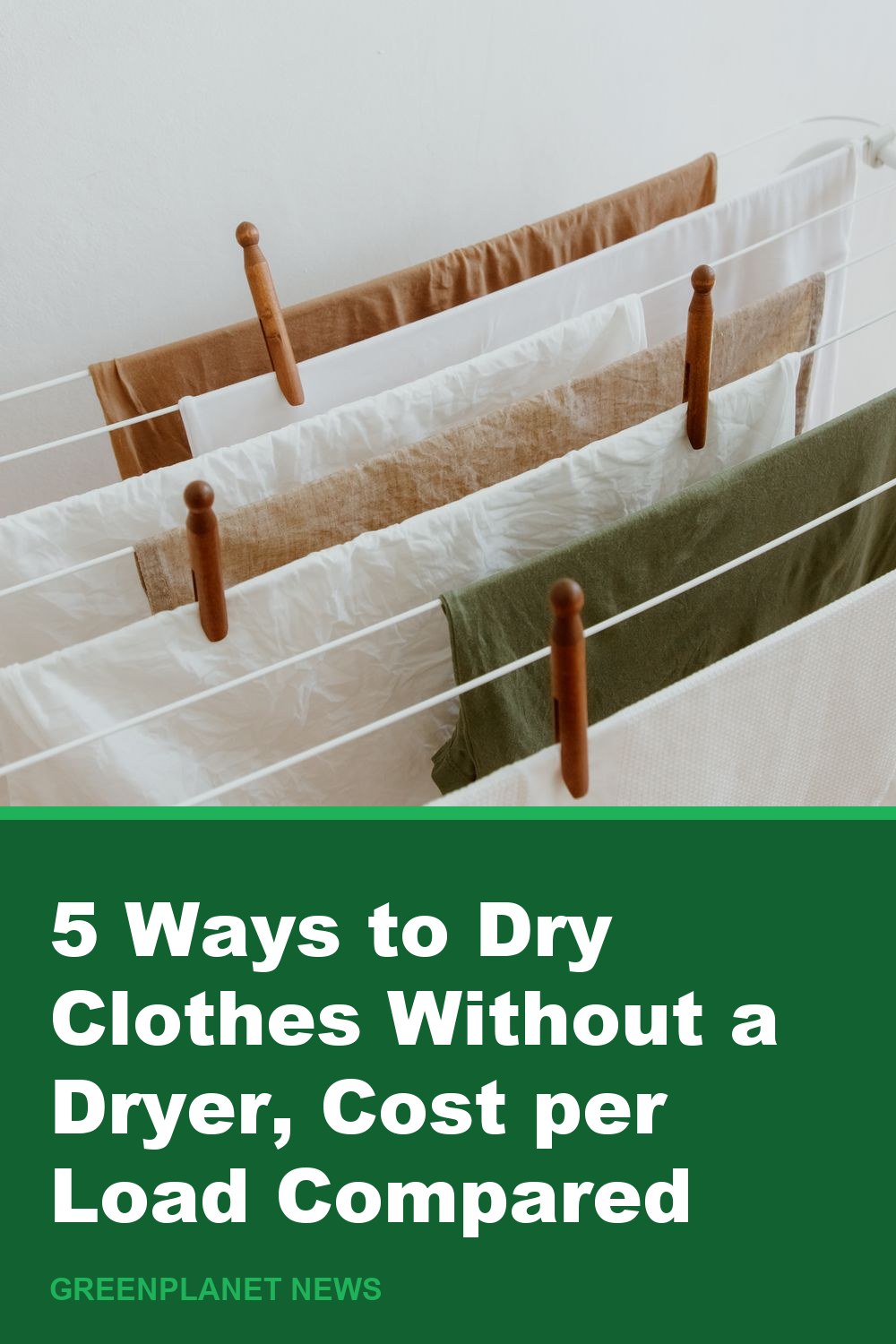

You've got a wet load in the drum and either no tumble dryer, or one you'd rather stop paying for. Maybe it's winter, you're in a flat with no garden, and the radiators are already draped in socks. You want to know which method actually costs least and still gets the clothes dry before they smell.
The short answer: a clothesline outdoors is free and usually fastest when the weather allows. Indoors, the cheapest reliable setup is an airer in a closed room with a dehumidifier, at roughly a third of a conventional dryer's running cost. Always spin at the highest speed the fabric tolerates first, because it costs pennies and shortens every other method.
The baseline and the maths
A conventional vented or condenser tumble dryer typically uses about 2 to 4.5 kWh for a full load, depending on load size and model. I'll use 3.5 kWh for a 7 kg load. At an example tariff of 30p per kWh, that's 3.5 × 0.30 = about £1.05 per load. Swap in the unit rate on your own bill (in the UK, Ofgem explains how unit rates and standing charges work). Three loads a week at £1.05 is roughly £160 a year.
One more number matters. A 7 kg load after a 1,200 rpm spin still holds roughly 3 to 4 litres of water. Evaporating one litre takes about 0.63 kWh of heat. That heat has to come from somewhere: the sun, your heating, or an appliance. Keep that in mind when a method looks "free".
| Method | Typical drying time | kWh per load | Cost at 30p/kWh | Upfront cost (approx.) |
|---|---|---|---|---|
| Tumble dryer (baseline) | 1.5–3 hours | 2–4.5 | £0.60–£1.35 | Already owned |
| Outdoor clothesline | 2–6 hours (warm, breezy) to 12+ hours (cool) | 0 | £0 | Roughly £10–£60 |
| Indoor airer by an open window | 12–36 hours | 0 direct (heating loss in winter) | £0 direct | Roughly £15–£50 |
| Heated clothes airer | 6–10 hours | 1–2.5 | £0.30–£0.75 | Usually £40–£120 |
| Airer plus dehumidifier | 4–8 hours | 0.6–2 | £0.18–£0.60 | Usually £120–£300 for the dehumidifier |
| Extra high-speed spin | Cuts later drying by roughly 15–30% | About 0.05–0.1 extra | £0.02–£0.03 | £0 |
Outdoor clothesline
Sun and wind supply all the evaporation energy, so the electricity cost is zero. On a warm, breezy day a full load is often dry in 2 to 6 hours. In cool, still, humid weather it can take all day and still come in slightly damp, which means finishing it indoors anyway.
Hang shirts from the hem, leave a hand's width between items, and put heavy towels at the windy end. A rotary line holds roughly two loads; a simple line between two points takes one.
Who it suits / who should skip it: anyone with a garden, yard or balcony and some dry days. Skip relying on it alone if you're in a long rainy season or your lease bans outdoor drying.
Indoor airer by an open window
A folding airer costs roughly £15 to £50 and uses no electricity. The catch is time and moisture: those 3 to 4 litres of water go into your room air, and a cracked window only moves it out slowly. Expect 12 to 36 hours for thick items.
In winter, the heat for evaporation comes from your heating system, plus you lose warm air through the open window. That's roughly 2 kWh of heat per load. With gas heating at an example 7p per kWh that's around 15p; with electric heating at 30p it's about 60p. Not free, just hidden on a different line of the bill.
Who it suits / who should skip it: small households in mild weather with a spare room. Skip it if your home already shows condensation on windows or black mould in corners.
Heated clothes airer
These are rails with low-power heating elements, usually rated around 100 to 300 W. At 230 W for 8 hours you get 1.84 kWh, or about 55p per load at 30p/kWh. That's roughly half a conventional dryer.
They dry items touching the bars well and bulky items poorly. A cover over the top, sold for many models, traps warm air and can shave a couple of hours off. The water still ends up in the room, so ventilation or a dehumidifier is still needed.
Who it suits / who should skip it: people drying smaller loads of thin fabrics such as shirts, underwear and baby clothes. Skip it if you mainly dry towels and jeans, or if your electricity rate is high and you have no other moisture control.
Airer plus dehumidifier
Put the airer in a small room, close the door, and run a dehumidifier next to it. A compressor model in the 10 to 20 litres per day class typically draws 150 to 300 W. Running 6 hours at 200 W is 1.2 kWh, about 36p per load. Many units have a laundry mode that runs flat out, then you switch off once the tank stops filling.
Here the dehumidifier is doing two jobs: drying clothes and protecting the house. Compressor units lose efficiency in cold rooms, roughly below 15°C; desiccant units work better there but draw more, often 300 to 650 W. Look for efficient models; ENERGY STAR lists certified dehumidifiers and dryers if you're comparing.
Who it suits / who should skip it: flat dwellers, winter driers and anyone with a damp problem. Skip it if you dry only one load a week in summer; the payback on a £200 unit at about 70p saved per load is roughly three years.
Keeping indoor humidity under control
- Buy a hygrometer (usually £5–£15) and aim for 40–60% relative humidity.
- If readings stay above about 70% for days, mould risk rises sharply; dry in one closed room, not the living space.
- Run kitchen and bathroom extractor fans while drying; the Energy Saver guidance on ventilation and moisture covers why spot extraction matters.
- Empty the dehumidifier tank, or use continuous drain, so it doesn't stop halfway.
- If someone in the home has asthma or allergies, ask a doctor about safe indoor humidity levels.
Extra high-speed spin cycle
This isn't a drying method on its own, but it's the cheapest step in every other one. Going from about 1,000 to 1,400 rpm can drop residual moisture noticeably; the exact figure varies by machine and fabric, but cutting the following drying time by 15 to 30% is typical. A few extra minutes of spin uses about 0.05 to 0.1 kWh, so 2 to 3p.
Use it for towels, jeans and cotton. Skip it for delicates, wool and some synthetics that crease badly; the care label decides.
Who it suits / who should skip it: everyone with a machine that offers it. The only reason to skip is fabric care.
Common mistakes
- Drying on radiators in a closed room with no extraction. It blocks heat from reaching the room and dumps litres of water into the air, which is how mould starts behind wardrobes.
- Overloading the airer. Items touching each other dry hours slower and can smell musty. One wash load usually needs a full-size airer; if it doesn't fit, split it.
- Running a dehumidifier in a big open space. In a whole living area it pulls moisture from every room and takes much longer. Close the door on a small room and it finishes in a fraction of the time.
Verdict
Outdoors when you can, at zero cost. Indoors, the airer plus dehumidifier gives the best balance of speed, cost and damp control at about a third of a conventional dryer's running cost, and it pays back fastest if you dry three or more loads a week in winter. A heated airer is a reasonable middle ground for small, light loads. The open-window airer is fine in mild weather but not genuinely free in winter. And whichever you pick, spin hard first: 2p to make everything else quicker is the best deal on this list.
Figures are worked examples: check your own tariff, the appliance labels and your local rules before you decide.
Watch or listen to this episode

I'm an Italian creator who builds apps, games and websites. I run GreenPlanet News with the help of AI tools: every article starts from the sources linked above, and I check what goes out. I'm not a doctor, a lawyer or a financial adviser. Spotted a mistake or have an idea? Write to me.
Instagram @spartaco_94_My websiteWrite to meAbout this blog










 Green Investing 101: A Beginner's Guide to Sustainable Investments





